

About this guide: If you’ve been hurt at work and aren’t sure what to do next, this complete guide covers everything you need to know about making a work injury claim in Australia — from who qualifies and what steps to follow, to the compensation you can receive and why getting legal help matters.
Getting injured at work turns your world upside down. One moment you’re doing your job; the next you’re in pain, staring at a pile of medical bills, wondering how you’re going to pay the mortgage if you can’t work. It’s stressful, it’s confusing, and — if you’ve never dealt with the workers’ compensation system before — it can feel like you’re completely alone in figuring it all out.
You’re not alone. And you’re not without options.
Australia has a workers’ compensation system specifically designed to protect you when a workplace injury happens. But knowing your rights and actually exercising them are two very different things. The system is complex, varies between states, and can feel deliberately difficult to navigate — especially when you’re injured and just trying to get better.
That’s what this guide is for. Whether your injury happened yesterday or months ago, whether you’ve already lodged a claim or haven’t started yet, we’ll walk you through exactly what a work injury claim is, who can make one, how the process works, what you’re entitled to, and — critically — how a specialist work injury lawyer can make the difference between a fair outcome and a settlement that leaves you short.
Read on. Your rights matter, and it’s time you understood them fully.
1. What Is a Work Injury Claim?
A work injury claim — also called a workers’ compensation claim — is a formal request for financial support and medical coverage when you’ve been injured or developed an illness as a direct result of your work. It’s not a lawsuit against your employer in the traditional sense. It’s a statutory entitlement: something the law guarantees you, regardless of who was at fault.
In Australia, workers’ compensation is managed at a state and territory level. That means the scheme you fall under depends on where you work — not necessarily where you live. The main schemes include:
- NSW: icare (Insurance & Care NSW) / SIRA
- Victoria: WorkSafe Victoria
- Queensland: WorkCover Queensland
- Western Australia: WorkCover WA (updated under the Workers’ Compensation and Injury Management Act 2023)
- South Australia: ReturnToWorkSA
- ACT / NT: Comcare (for Commonwealth employees) and territory-based schemes
Each scheme has its own rules, time limits, and benefit structures. But the core premise is the same: if you’re injured at work, you should not be left financially devastated. Our experienced work injury lawyers can advise you on the specific scheme that applies to your situation.
Important: Workers’ compensation covers more than physical injuries on the job. It can also cover illnesses caused by working conditions, aggravated pre-existing conditions, and — increasingly — psychological injuries like anxiety, depression, and PTSD arising from workplace events.
2. Who Can Make a Work Injury Claim in Australia?
If you’ve been injured while performing work duties, there’s a good chance you’re eligible to make a work injury claim — but the rules around eligibility matter. Let’s break it down.
You generally qualify if you are:
- A full-time, part-time, or casual employee
- An apprentice or trainee
- A labour hire or on-hire worker
- In some states, a working director or outworker
- Injured during a work-related activity, including travel (in some circumstances)
Situations that are typically covered:
- Physical injuries that happen suddenly (e.g., a fall, lifting injury, machinery accident)
- Gradual onset injuries from repetitive tasks (e.g., repetitive strain, back degeneration)
- Occupational diseases (e.g., occupational asthma, skin conditions)
- Psychological conditions arising from workplace stress, trauma, or harassment
- Pre-existing conditions that were significantly worsened by your work duties
Who may not be covered?
Independent contractors and genuine sole traders are generally not covered under standard workers’ compensation schemes, though this can depend on the nature of the working arrangement.
| Time limits matter: Every state has strict deadlines for lodging a work injury claim. In most jurisdictions, you have between 6 months and 3 years from the date of injury (or first becoming aware of an injury) to make a claim. Don’t wait — delay can cost you your entitlements. |
3. Common Types of Workplace Injuries
Workplace injuries come in many forms — some happen in an instant; others develop slowly over months or years. According to Safe Work Australia’s Key Work Health and Safety Statistics Australia 2025 report, there were 146,700 serious workers’ compensation claims in 2023–24 — that’s more than 400 serious claims lodged every single day across the country.
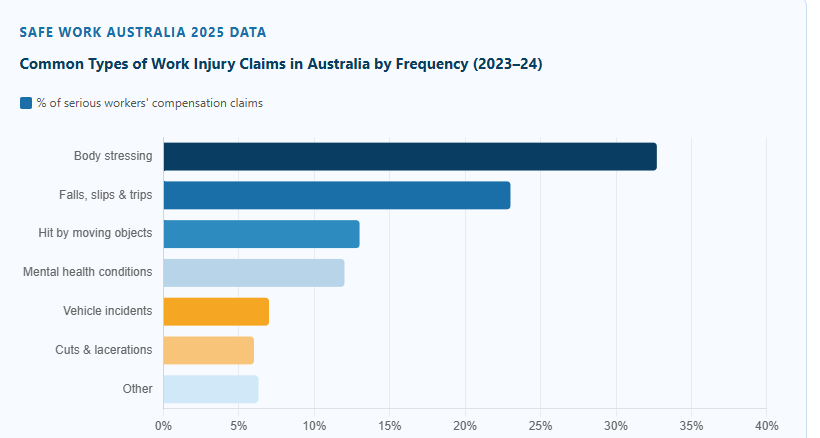
Body Stressing (32.7% of serious claims)
The single biggest category. Body stressing includes muscular stress from lifting, carrying, putting down objects, and repetitive movements. Back injuries are the most common sub-type. Jobs in warehousing, nursing, construction, and manufacturing carry the highest risk.
Falls, Slips, and Trips (approx. 23%)
Falls from height and slips on wet or uneven surfaces are among the most serious workplace incidents. These are leading causes of both serious injuries and fatalities, particularly in construction and agriculture.
Being Hit by Moving Objects (approx. 13%)
This includes being struck by tools, machinery, vehicles, or falling materials — common in manufacturing, construction, and warehousing environments.
Mental Health Conditions (approx. 12% and rising)
Mental health claims have surged significantly — up 97.3% over the past decade. The median time lost from work for mental health claims is almost five times longer than the median for physical injuries, making early legal and medical intervention critical.
Vehicle Incidents (42% of all fatalities)
Vehicle-related incidents are the leading cause of work-related deaths in Australia, accounting for 42% of all workplace fatalities in 2024 — more than triple the next most deadly cause. They are heavily concentrated in transport, logistics, and agriculture.
Other Common Injuries Include:
- Cuts, lacerations, and puncture wounds
- Burns (thermal and chemical)
- Fractures and dislocations
- Occupational diseases (e.g., dust diseases, asbestosis, occupational asthma)
- Hearing loss from workplace noise
- Crush injuries from machinery or equipment
4. Steps to File a Work Injury Claim
The workers’ compensation process can feel daunting, but when you break it down into steps it becomes much more manageable. Here’s what to do:
Report your injury to your employer immediately.
Tell your employer (or supervisor) about your injury as soon as possible — ideally in writing. Most schemes require notification within 30 days, though you should act sooner wherever possible. Delay can create doubt about whether the injury is genuine or work-related.
Seek medical treatment and get a Certificate of Capacity.
See a doctor — both to treat your injury and to start the documentation process. Your treating doctor will provide a WorkCover medical certificate (or equivalent depending on your state) that confirms the injury and assesses your capacity to work. Keep copies of every medical report, prescription, and referral.
Lodge your workers’ compensation claim.
Fill in and submit a workers’ compensation claim form to your employer’s insurer. Your employer must provide you with this form and assist you in the process. Most schemes allow you to lodge directly with the insurer if your employer is uncooperative.
Wait for the insurer’s decision.
The insurer has a set timeframe to accept or dispute your claim (typically 7–28 days depending on the jurisdiction). During this time, some schemes offer provisional payments. If your claim is accepted, your weekly payments and medical expense reimbursements should begin promptly.
Follow your Return to Work plan.
You are generally required to participate in reasonable rehabilitation and return-to-work activities. Keep all your medical appointments and cooperate with your insurer’s rehabilitation provider — but don’t agree to anything that puts your health at risk.
Dispute the decision if your claim is denied or underpaid.
If your claim is rejected, or you believe your compensation is inadequate, you have the right to dispute the decision. This is where having a specialist work injury lawyer is invaluable — they can navigate dispute processes, appeals, and negotiations on your behalf.
Consider a lump sum or common law claim.
Depending on the severity of your injury and your state, you may also be eligible for a lump sum payment for permanent impairment and/or a common law damages claim if your employer’s negligence caused or contributed to your injury.
5. What Compensation Can You Receive?
One of the most common questions we hear is: “What am I actually entitled to?” The answer depends on your state, the severity of your injury, and whether negligence was involved — but here’s a clear breakdown of the main types of compensation available through a work injury claim in Australia.
| 146,700 Serious workers’ comp claims in Australia, 2023–24 | $16,300 Average payout per serious claim | 7.4 wks Median time lost from work per claim | $1.27B Paid to injured NSW workers in 12 months to Sept 2025 |
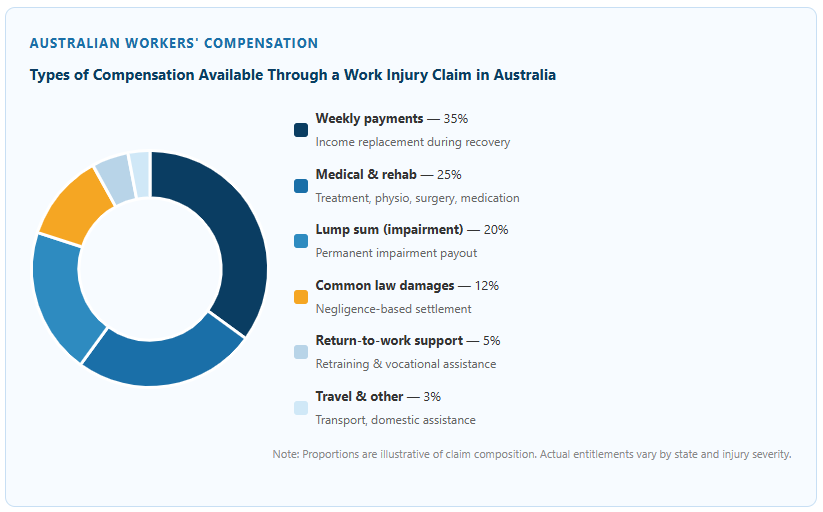
1. Weekly Payments (Income Replacement)
If you can’t work because of your injury, you’re entitled to weekly payments to replace your lost income. In NSW, for example, this is up to 95% of your pre-injury earnings for the first 13 weeks, then around 80% from week 14 onwards, up to a maximum of approximately $2,604.80 per week (as of early 2026). Other states have similar structures — the exact amount and duration depend on your jurisdiction and degree of impairment.
2. Medical and Rehabilitation Expenses
Your insurer is required to cover reasonable costs of medical treatment, specialist appointments, surgery, physiotherapy, medication, and workplace rehabilitation. The scope of this coverage varies by state and your level of impairment — in serious cases, it can extend to lifetime medical expenses.
3. Lump Sum for Permanent Impairment
If your injury results in a permanent impairment, you may be entitled to a lump sum payment assessed against your Whole Person Impairment (WPI) percentage. In NSW, lump sums range from $22,480 up to a maximum of $757,760 for the most serious permanent injuries (for those assessed at 11% WPI or higher).
4. Common Law Damages
If your employer’s negligence caused or contributed to your injury, and your permanent impairment reaches the required threshold (15% WPI in NSW), you may be able to pursue a work injury damages claim — a common law settlement on top of your statutory entitlements. These payouts can be substantial for serious injuries.
5. Return-to-Work and Vocational Support
Workplace rehabilitation, retraining support, and modified duties arrangements are also part of the compensation framework — designed to help you return to meaningful employment where possible.
6. Other Entitlements
- Travel expenses to medical appointments
- Domestic assistance if you can’t manage household tasks
- Funeral expenses and dependency payments (in fatal injury cases)
Don’t settle too early: Insurance companies often offer early settlements that don’t reflect the full long-term impact of your injury. Before accepting any offer, speak to our experienced work injury lawyers — many workers leave significant money on the table by settling without legal advice.
6. Why You Should Hire a Work Injury Lawyer
You have the legal right to make a work injury claim on your own. But that doesn’t mean you should. The workers’ compensation system is complex, time-sensitive, and — frankly — designed to be navigated by professionals. Here’s why having a specialist lawyer in your corner makes a real difference.
They know the system inside out
Each state has different rules, thresholds, and timelines. A specialist work injury lawyer understands the specific scheme that applies to you — whether that’s icare in NSW, WorkSafe in Victoria, or WorkCover in Queensland — and knows how to maximise your entitlements within that framework.
They deal with disputed and rejected claims
Insurers dispute claims for many reasons — sometimes legitimately, sometimes not. If your claim has been rejected or underpaid, a lawyer can challenge that decision through the correct dispute resolution process. Many workers who initially receive nothing end up with full entitlements after legal intervention.
They can identify all available avenues of compensation
Many workers don’t realise they may be eligible for both statutory workers’ compensation and a separate common law damages claim — or that a third party (like a labour hire company or equipment manufacturer) may share liability. A lawyer assesses all possible claims, not just the obvious one.
They level the playing field
Insurers have entire legal teams working to limit payouts. You deserve equally experienced representation. Our work injury lawyers work on a no-win, no-fee basis for eligible matters — so you won’t pay legal fees unless we win your case.
They manage the paperwork and deadlines
Missing a deadline or lodging incomplete paperwork can cost you your entitlements. A good lawyer handles all of this for you so you can focus on what matters most: your recovery.
They take the stress off your shoulders
Dealing with an insurer while injured and unable to work is exhausting. Having a specialist handle communications, disputes, and negotiations on your behalf gives you breathing room to focus on getting better.
7. Tips to Strengthen Your Work Injury Claim
Not every work injury claim is straightforward. Insurers will scrutinise your claim, and the strength of your evidence can make a significant difference to the outcome. Here are practical steps to protect yourself and maximise your chances of a successful claim.
Report immediately and in writing. Verbal reports can be denied or forgotten. Put it in writing — a text message, email, or incident report form — and keep a copy.
See a doctor on the day of injury (or as soon as possible). A gap between the injury and your first medical visit gives insurers room to argue the injury didn’t happen at work or isn’t as serious as you claim.
Be honest and consistent with your doctors. Inconsistencies in how you describe your injury — even minor ones — can undermine your credibility. Tell the full story, every time, accurately.
Document everything. Keep all medical certificates, receipts, reports, correspondence, and wage records. A chronological file of your injury’s impact is powerful evidence.
Gather witness details. If anyone saw your injury happen, get their name and contact information. Witness accounts can be critical if the incident is disputed.
Photograph the hazard or scene. If it’s safe to do so, photograph the location, equipment, or conditions that caused your injury before they’re fixed or changed.
Attend all medical appointments. Failing to attend appointments signals to the insurer that you’re not taking your recovery seriously and can affect your entitlements.
Get legal advice early — even before lodging your claim. The earlier you speak to a work injury lawyer, the better positioned you are to avoid common mistakes that can harm your claim.