

About this guide: If you’ve been hurt at work in Victoria and need to understand your rights, this complete guide to WorkCover Lawyers Melbourne covers everything — from who qualifies under the WIRC Act, to claim types, payout ranges, when to get legal help, and how to choose the right lawyer for your situation.
If you’ve been injured at work in Melbourne or anywhere in Victoria, you don’t have to face the WorkCover system alone. Whether you’ve just been hurt on the job or you’ve been struggling through a disputed claim for months, getting the right legal advice from experienced WorkCover lawyers in Melbourne can be the single most important step you take.
The Victorian WorkCover scheme — administered by WorkSafe Victoria under the Workplace Injury Rehabilitation and Compensation Act 2013 (WIRC Act) — is one of Australia’s most comprehensive workers’ compensation frameworks. But comprehensive doesn’t mean simple. Navigating the scheme, meeting deadlines, dealing with insurer disputes, and understanding your entitlements to lump sums, weekly payments, and common law damages is genuinely complex work.
Every single day across Victoria, more than 400 serious workers’ compensation claims are lodged. Behind every one of those is a real person — someone who went to work expecting to come home safely, and didn’t. If you’re one of them, this guide is for you.
We’ll walk you through what a WorkCover claim actually covers, who qualifies, when you need legal support, what injuries are recognised under the scheme, how the payout system works, and how to choose the right WorkCover lawyer in Melbourne to put you in the strongest possible position.
1. Understanding What a WorkCover Claim Is
WorkCover is Victoria’s workers’ compensation insurance scheme. It protects workers who are injured or become ill as a result of their work, providing financial support and access to medical care while they recover. It is a no-fault scheme — meaning you can make a claim even if your own actions contributed to the incident. You don’t need to prove your employer was negligent just to access the basic entitlements.
The scheme is established and governed by the Workplace Injury Rehabilitation and Compensation Act 2013 (Vic) — commonly referred to as the WIRC Act. On 6 August 2025, amendments to the WIRC Act came into effect, further strengthening support for injured workers and the families of workers who die as a result of work-related injuries.
What does a WorkCover claim cover?
Once your claim is accepted by WorkSafe Victoria or an authorised agent, you may be entitled to:
- Weekly payments — income replacement while you are unable to work, up to a statutory maximum of $2,930 per week (as at 1 July 2025)
- Medical and treatment expenses — including doctor visits, surgery, physiotherapy, medication, and necessary medical aids
- Rehabilitation support — vocational rehabilitation, workplace modifications, and return-to-work programmes
- Superannuation contributions — paid on top of weekly payments after 52 weeks in eligible cases
- Impairment benefit (lump sum) — for workers who sustain permanent impairment, once injuries have stabilised (generally at least 12 months post-injury)
- Common law damages — for workers with a certified serious injury caused by employer negligence, covering pain and suffering and economic loss
| $2,930 Maximum weekly payment as at 1 July 2025 | 400+ Serious claims lodged across Australia every day | 146,700 Serious workers’ comp claims nationally in 2023–24 | No-fault Scheme — you can claim even if partly at fault |
2. Who Is Eligible for WorkCover in Victoria?
Eligibility for the Victorian WorkCover scheme is broad — but understanding where you sit is important. You are generally eligible if you are a worker as defined under the WIRC Act and you have suffered an injury or illness that is work-related.
Who counts as a “worker” under the WIRC Act?
- Full-time, part-time, and casual employees
- Apprentices and trainees
- Labour hire and on-hire workers (covered under the host employer’s policy)
- Working directors in some circumstances
- Outworkers and some contractors who are engaged primarily for their personal labour
Independent contractors and sole traders operating their own businesses are generally not covered under WorkCover. However, the distinction between an employee and a contractor is not always clear-cut — it depends on the actual working arrangement rather than just what the contract says. If you’re uncertain whether you qualify, speaking with our experienced workers’ compensation lawyers is the safest first step.
What counts as a work-related injury?
Your injury or illness must arise out of or in the course of your employment. This includes:
- Injuries that occur on work premises during work hours
- Injuries sustained while travelling for work purposes
- Injuries that occur during authorised breaks in the workplace
- Gradual onset injuries caused by the cumulative nature of your work duties
- Occupational diseases caused or significantly aggravated by work conditions
- Psychological injuries where work is a significant contributing factor
Important time limits: In Victoria, you must report a workplace injury to your employer as soon as possible and no later than 30 days after the injury. Claims must generally be lodged within 12 months of the injury date. Don’t delay — missing these deadlines can affect your entitlements.
3. When Should You Contact a WorkCover Lawyer?
Many workers assume they only need a lawyer if something goes wrong with their claim. In reality, getting early legal advice — even before you lodge your claim — can significantly improve your outcome. Here’s when it’s particularly important to contact WorkCover lawyers in Melbourne:
Before lodging your claim
A lawyer can ensure your claim form correctly captures all injuries — including conditions you may have overlooked. Missing an injury at this stage can mean falling below the threshold for lump sum entitlements later.
If your claim has been rejected
WorkSafe agents reject claims for many reasons — sometimes legitimately, sometimes not. You have the right to dispute a rejection through the Workplace Injury Commission (formerly the Accident Compensation Conciliation Service). A lawyer navigates this for you.
If your weekly payments have been reduced or stopped
Insurers can terminate or reduce weekly payments based on capacity assessments. A lawyer can challenge these decisions if they don’t accurately reflect your actual condition.
When considering a lump sum impairment claim
Impairment assessments are complex. Making sure all your injuries are correctly included and assessed — especially both physical and psychiatric conditions — requires specialist input. Errors here are difficult or impossible to correct after the fact.
When pursuing a common law damages claim
If you’ve suffered a serious injury and your employer’s negligence contributed to your harm, you may be entitled to pursue common law damages. This is a legally complex process requiring strong evidence and specialist representation.
If your employer is pressuring you to return to work prematurely
Your employer has obligations around return to work, but those obligations work both ways. A lawyer can protect you from being forced back before you are ready.
If your injury involves a third party
Sometimes a third party (such as a subcontractor, vehicle driver, or equipment manufacturer) is partially responsible for your injury. A lawyer can assess whether an additional claim is available alongside your WorkCover claim.
4. What Injuries Are Covered Under WorkCover?
The Victorian WorkCover scheme recognises a wide range of injuries and illnesses — far broader than many workers realise. Under the WIRC Act, a “workplace injury” includes any physical or mental injury, disease, or aggravation of a pre-existing condition that arises substantially from a worker’s employment.
Physical injuries
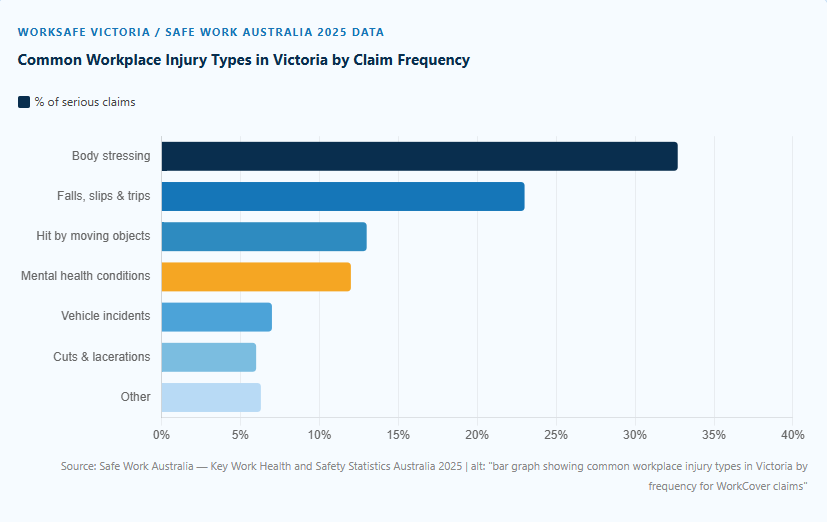
- Back, neck, and spinal injuries (the most common category — musculoskeletal “body stressing” accounts for over 32% of all serious claims nationally)
- Shoulder, knee, hip, and joint injuries from repetitive motion or sudden trauma
- Fractures and dislocations from falls, being struck, or machinery accidents
- Lacerations, crush injuries, and burns in industrial or construction environments
- Hearing loss caused by prolonged workplace noise exposure
- Occupational diseases such as asbestosis, silicosis, occupational asthma, and skin conditions
- Bursitis, tendinitis, and other repetitive strain conditions
Psychological and mental health injuries
Mental health claims under WorkCover have grown significantly and are now a major — and important — part of the scheme. From 31 March 2024, new requirements apply to psychological injury claims under WorkCover, including mandatory DSM (Diagnostic and Statistical Manual of Mental Disorders) diagnoses on Certificates of Capacity.
- Post-traumatic stress disorder (PTSD) from a traumatic workplace event
- Anxiety and depression arising substantially from work conditions
- Adjustment disorders, burnout, and stress-related conditions where work is a significant contributing factor
- Psychological injuries resulting from workplace bullying, harassment, or discrimination
| Psychological injury claims: Under the WIRC Act, a psychological injury claim will not be accepted if the injury arises from “reasonable management action” taken in a reasonable manner — such as performance management or disciplinary processes. Getting legal advice early helps you understand whether this exclusion applies to your circumstances. |
Aggravated pre-existing conditions
A pre-existing condition can be covered if your work duties caused a significant aggravation, acceleration, or deterioration of that condition. You don’t need a clean bill of health before your injury date to make a valid claim.
5. When Can Your Claim Be Rejected?
WorkSafe agents can and do reject WorkCover claims — and rejection doesn’t necessarily mean your claim is invalid. Understanding the common grounds for rejection helps you anticipate challenges and respond effectively.
Common grounds for claim rejection
- The injury did not arise out of or in the course of employment — the agent disputes the connection between your work and your injury
- Reasonable management action defence — particularly relevant to psychological injury claims; if the injury arose from a performance review, restructure, or disciplinary process conducted in a reasonable manner, the claim may be excluded
- Delay in reporting — failing to notify your employer within 30 days of the injury without a reasonable excuse can affect claim acceptance
- Insufficient medical evidence — the claim is not supported by adequate documentation from a treating medical practitioner
- Dispute about whether you are a “worker” — especially where there is an argument that you are an independent contractor rather than an employee
- Injury occurred during an activity that was not part of your employment — e.g., social events, commuting (unless work-related travel)
What can you do if your claim is rejected?
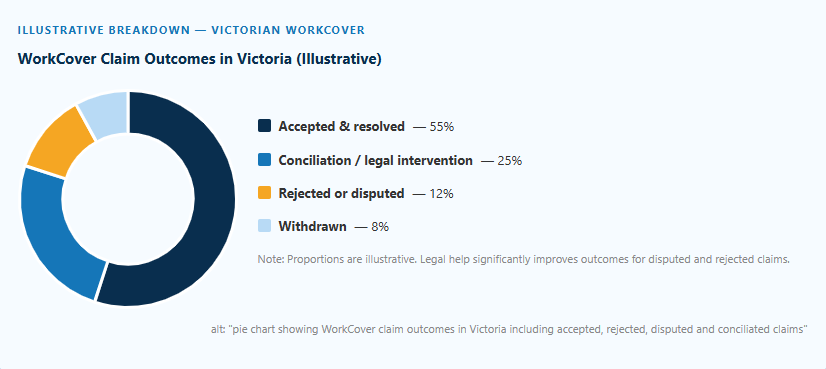
A rejection is not the end of the road. You have 60 days from the date of the rejection notice to lodge a request for conciliation with the Workplace Injury Commission (WIC). Conciliation is a free, informal process aimed at resolving disputes without going to court. If conciliation doesn’t resolve the issue, the matter can proceed to arbitration or the County Court of Victoria.
Don’t miss the 60-day window: If your WorkCover claim is rejected and you want to dispute it, you must act within 60 days. Contact our WorkCover lawyers team promptly — we can assess your situation and guide you through the conciliation process.
6. Why Choose Workplace Injury Lawyers?
At Workplace Injury Lawyers, we are exclusively focused on helping injured workers throughout Victoria navigate the WorkCover system and secure the compensation they deserve. Here’s what sets us apart:
We specialise in WorkCover — nothing else
Unlike general practice firms that treat WorkCover as one of many areas they handle, our team works on workers’ compensation matters every day. That depth of experience means we understand how WorkSafe agents operate, what triggers disputes, and how to build the strongest possible case for our clients.
No Win, No Fee
We understand that injured workers are often under significant financial pressure. That’s why we offer a No Win, No Fee arrangement for eligible matters — you won’t pay legal fees unless we achieve a successful outcome for you.
Free initial consultation
Every new client receives a free, no-obligation consultation where we review your situation, explain your rights clearly, and map out the options available to you — in plain Australian English, without the legal jargon.
We handle the insurer so you don’t have to
Dealing with WorkSafe agents and insurers is time-consuming and stressful — especially when you’re injured and trying to recover. We manage all communications, document gathering, and negotiations on your behalf, protecting you from tactics designed to minimise your entitlements.
We maximise your total entitlements
Many workers receive their initial weekly payments and assume that’s all they’re entitled to. In reality, there may also be impairment benefit lump sums, superannuation contributions, and common law damages available.
We know Melbourne and Victoria
Our team is based in Victoria and understands the specific industries, workplaces, and injury patterns that are common across Melbourne and regional Victoria — from construction and manufacturing in the western suburbs to healthcare and hospitality in the CBD and inner city.
7. Tips for Choosing the Right WorkCover Lawyer in Melbourne
Not all lawyers are equal when it comes to WorkCover claims. Choosing the right one can make a significant difference to the outcome of your case. Here’s what to look for:
- Specialisation in workers’ compensation. Choose a lawyer or firm that specifically handles WorkCover claims — not a generalist who dabbles across many areas. The scheme’s rules, thresholds, and processes are technical enough that specialist knowledge genuinely matters.
- Victorian experience. Workers’ compensation is state-based. Make sure your lawyer understands the WIRC Act, the Victorian Workplace Injury Commission, and the specific practices of WorkSafe agents operating in Victoria.
- No Win, No Fee. Any reputable WorkCover lawyer in Melbourne should offer a no win, no fee arrangement for eligible matters. Be cautious of firms that ask for upfront payment before they’ve assessed your claim.
- Clear, jargon-free communication. The WorkCover system is complex enough without your own lawyer making it harder to understand. Look for someone who explains things plainly and keeps you informed at every step.
- Genuine empathy. A good WorkCover lawyer understands that behind every claim is a real person dealing with pain, uncertainty, and financial stress. You deserve someone who treats you with respect — not as a file number.
- A track record of results. Ask about the firm’s experience with cases similar to yours. Have they handled disputed claims? Psychological injury claims? Common law damages matters? Real-world experience in your specific situation matters.
- Accessibility. You should be able to reach your lawyer when you need them, and receive timely updates on your claim. Ask about how communication is handled before you engage.
| Tip: Your first consultation should be free. Use it to ask direct questions about the lawyer’s experience with WorkCover claims specifically, their approach to your type of injury, and what timeline you might expect. A good lawyer welcomes these questions. |
Conclusion: Your WorkCover Rights Are Worth Protecting
Getting injured at work in Victoria is stressful enough without having to fight the system on your own. The good news is: you don’t have to. The Victorian WorkCover scheme exists to support you — but accessing your full entitlements requires understanding the scheme, meeting its deadlines, and knowing when to get specialist legal help.
Here’s what to take away from this guide:
- WorkCover is a no-fault scheme — you can claim even if you were partly at fault for your injury
- Both physical and psychological injuries are covered under the WIRC Act
- Weekly payments can reach up to $2,930 per week (as at July 2025), with lump sums and common law damages available for more serious injuries
- Time limits matter — report your injury promptly and don’t miss the 60-day conciliation window if your claim is rejected
- Getting legal advice early — even before lodging your claim — can make a substantial difference to your outcome
- Choose a WorkCover lawyer in Melbourne who specialises in the scheme, knows Victorian law, and works on a No Win, No Fee basis
If you’ve been injured at work, the team at Workplace Injury Lawyers is here to help. We offer a free initial consultation, and we work on a No Win, No Fee basis for eligible matters. You focus on your recovery — we’ll handle the rest.